Tuesday, January 3, 2012

What to Expect from Us in 2012

 
 Heidi celebrating an 80 degree San Diego Christmas

 Lemon sharks in holding shortly after arrival

2011 was a good year for aquariums at the VLM. We lost a couple of excellent employees to the beaches of Southern California (Newport News vs San Diego? Come on Heidi!) and another to the corporate world (an unnamed amount of money vs. two times that unnamed amount of money? Come on Jessi!), but were fortunate to replace them with two more excellent employees. Also in 2011, we acquired our lemon sharks, completely renovated the Skate/Ray exhibit, completely renovated the Mtn. Stream exhibit and acquired 10 Roanoke logperch to become the only public facility to display them, completely renovated the Coral Reef exhibit - and its life-support system - with all new corals, anemones and fishes, and that's just SOME of the major projects that we successfully completed. So what do we have planned for 2012?

We will likely improve or completely replace the ghost crab exhibit. Admittedly it is hard to create something more inspirational and awe-inducing than an exhibit full of holes in the sand and the possibility of catching a glimpse of the leg of a ghost crab, but ...we may need something new.


Several of the fishes in CBA, including the cobia, need to be downsized


We will definitely need to down-size CBA; to what degree remains to be seen. This will be a daunting task, but one I have been continually preparing for over the past several years, actually just "continually" is more accurate. Because we collect 99.5% of all our fishes here (with the exception of our reef species), fishes for the Chesapeake Bay Aquarium must be either caught large enough to hold their own against the grouper, shark, sea turtle and jacks (> 20"), or must be raised to that stage. In many cases this process takes years. But we are at the point where it would be prudent to de-accession the lemon shark as he is growing very rapidly (for the safety of the divers and the turtle), and several of the animals (red drum, crevalle jacks, cobia) have become very large and aggressive towards other fishes. They will be replaced by animals currently in holding that are smaller and can be displayed safely (for them and other fishes) for many years to come. We actually have four cobia, two bluefish, four crevalle jacks, several permit, stripers that should be big enough by summer, and a tarpon, spotted sea trout, and red drum that may be ready within a year. Every year we collect many other potential fishes as well, but the available species vary yearly and their availability fluctuates seasonally.

In conjunction with down-sizing CBA is replacing the lemon shark. The lemons are the squirreliest sharks we have had, the most aggressive, but also my favorite. Not only are they beautiful animals, but our lemon has a lot of personality. I will certainly miss him. I will either have to acquire a replacement shark from another institution (of whatever species comes available - usually sandbar, blacktip, bonnethead, lemon) or catch one myself. More on that in the spring.

We also may be changing other exhibits to...well simply have something new, perhaps even changing some of them on a regular basis. Although we are happy with the majority of our exhibits, change excites interest for the visitors and keeps the staff engaged and learning. A wish list from my own head? Here are a few ideas:

 A juvenile blue angel I collected on vacation in Nags Head


Tropical migrants - many tropical juveniles are brought passively up the gulf stream into VA an NC where they survive until fall. They are temporary, but are getting more common and may become permanent. (species - grey angel, blue angel, french angel, goatfish, tang sp, wrasse sp., etc)


Continental shelf - a cold water exhibit with replica whale bones and deep water species such as deep water isopods, cod, golden crabs, lumpfish, squirrelfish, sea robins, tilefish etc.

Green moray - a replica ship wreck/reef with a large green moray (eerie lighting, feedings for the public)

Sea turtle hatchling nursery - there are many obstacles for this and i must be careful what I "wish for"

These are just a a few ideas. In the meantime we have thousands of animals to care for and existing exhibits that must be cared for and displayed with our highest standards. I cannot promise what new ventures we will undertake for 2012, but I do promise that whatever exhibits we do have we will keep them clean, attractive, and provide the animals (including holding) the best possible care.

Oh, and I resolve to write about it! And I DID shoot a video during the dive (to those who read the previous blog) which will be coming this week.

We wish you a happy healthy 2012.

Monday, December 26, 2011

Coming Soon: Underwater Videos!

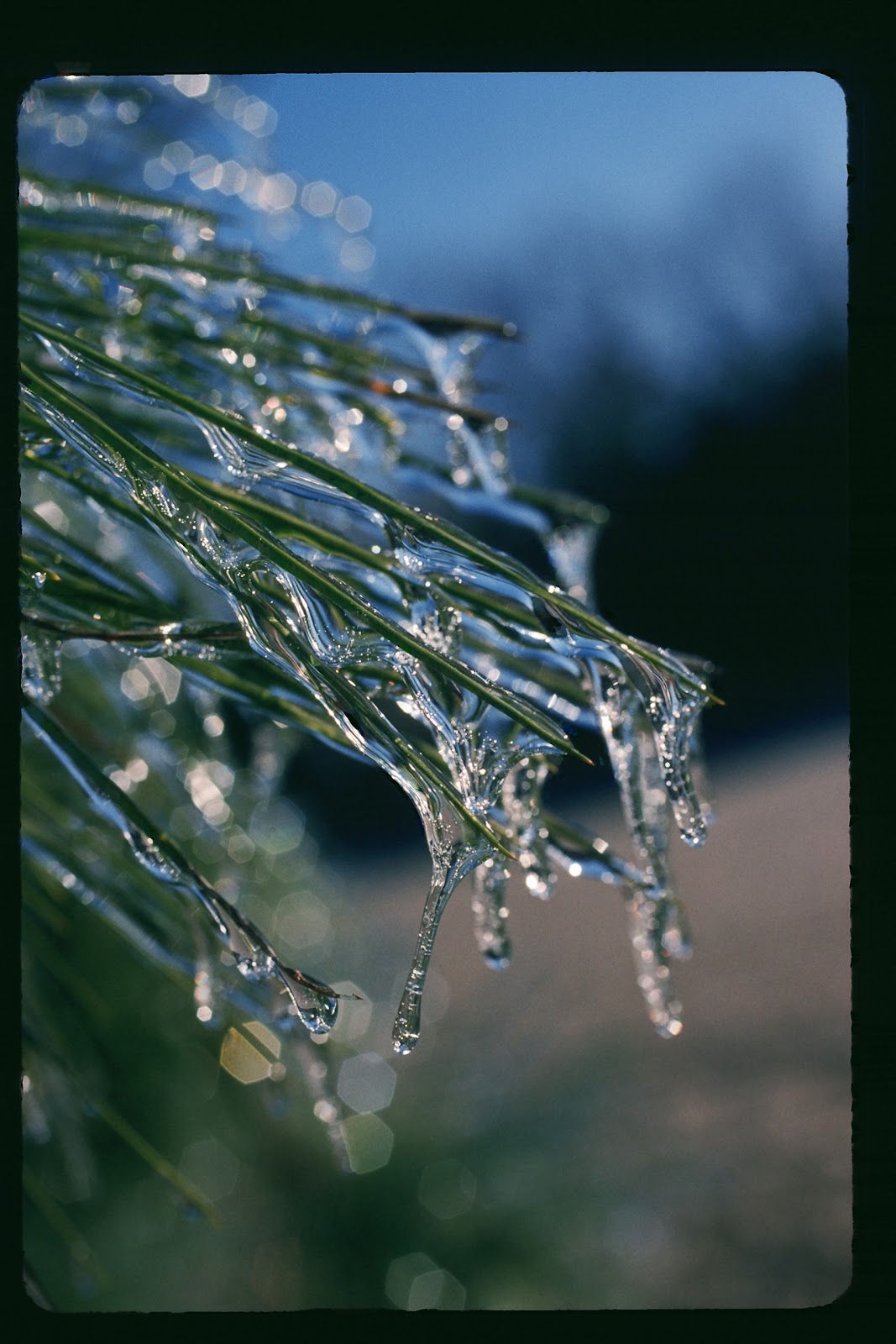
Ice on Pines
I have always preferred using film cameras, especially with slide film, because of the clarity, color saturation,  and super-fine grain. I take pride in creating and using original images here at the VLM for my blog, articles etc. Photographing fishes requires a lot of creative lighting and film solutions to shooting in, through, or above water and I love to get underwater images whenever possible. However, shooting underwater requires fast film (poor for color and image quality) and lots of light, usually external flashes or strobes. This is not only disruptive to the fishes in the tank, but impractical. But now, thanks to Santa's generosity, I will soon be able to produce high quality digital underwater pictures and videos. Our next dive is Thursday December 29th and I hope to produce at least a few images to post on this blog, so keep an eye out for them. Around New Year's we will also be writing about our upcoming projects for the year and hopefully some updated or entirely new exhibits! Have a great holiday season from the aquarium department at the VLM.

Tuesday, December 13, 2011

Chain Pickerel

Chain Pickerel Esox niger, are a species of fresh water fish most commonly found in rivers and streams. They are named for the chain-like markings along their sides. Pickerel have long, thin bodies and broad, rounded, beak-like rostrums, with a distinctive vertical bar beneath the eye. Their mouths are full of sharp teeth and they can eat anything that is half their size (even mice!). Pickerel usually grow to about two to three feet in length. Pickerel, which are part of the pike family, are difficult to net because they reside in shallow water and move very quickly, making it an exciting catch if one is ever obtained. Luckily, Chris Crippen and myself, Sarah Peake, were able to snag one a few months ago in the Little Creek Reservoir.
We were both looking forward to seining a juvenile pickerel. I got really excited when we spotted one about 8 inches in length sitting in the water we were about to collect from. Unfortunately, we quickly found out that the pickerel were not only faster than we could pull the seine net, but were smart, and avoided the net with ease. To our disadvantage, pickerel often hang out in weedy habitats, making it even harder to pull the seine quickly enough to net one. At the end of the day (and after much frustration of pulling the net over and over again and catching a lot of weeds), we were feeling rather disappointed. Chris decided to try one more spot a few yards down. I pulled the seine out and moved along the bank of the water as quickly as I could.  Before I could even get back on shore Chris saw that I had netted one, so we moved quickly to grab it and put it in our bucket. We were both so excited to finally have gotten one, and a good sized one it was (about 6-7 inches in length). Following tradition, I named her Sarah, after myself (she who catches the prize gets to name it after themselves).
                               Sarah, with a full belly of golden shiners.

So far Sarah has grown to about 8 inches in length. She is eating live food, mostly rosie red goldfish, and has become a favorite among the aquarists to feed. As many of us say, she "annihilates" her prey quickly, to say the least.
We still keep her in quarantine, since it can be tricky to acclimate a pickerel onto exhibit for a few reasons. For one, pickerel tend to stay sedimentary, and because of this they can be easy targets for other larger fish and/or turtles on exhibit. Another concern is that they mostly eat live food. Though it is possible to get them to eat frozen fish, it can be difficult. If she is the only one on that particular exhibit that eats live food, and she is not moving around like the other fish, she may not get to the food in time, and will have lost her meal to the other fish.
                                                  Sarah and Sarah

Sarah needs to get a little larger before we put her in our Woodland Pond exhibit. Once we feel she is big enough we will move her into the exhibit where she will live until she gets too big (she'll then move into the Cypress Swamp exhibit). So for now, Sarah remains behind the scenes in quarantine, and will be on exhibit soon enough.

By: Sarah Peake

Friday, November 25, 2011

Reef Update

The Coral Reef Exhibit has been running well, the water cleared and the chemistry has stabilized. It is now the new home for several corals, anemones, and fishes. As the system matures, each animal will find its home within the exhibit and learn how to interact with their tank mates. Already the bubble-tip anemone has moved several times. Anemones can be very mobile and often move about at night to find the most suitable combination of light and current.

 
 A bubble-tip anemone on exhibit about 16 inches across

Similarly, soft corals have the ability to move as well, but not nearly as fast or as often as anemones. Soft corals are just that, soft; they lack the calcareous skeletons of stony or hard corals that create reef structures. Soft corals are also generally less reliant upon symbiotic zooxanthellae as hard corals and therefore do not need as much light.
Two different species of hairy mushroom corals in the exhibit.
Corals can vary widely as to flow requirements, light levels, and feeding behavior, and positioning is critical. Often one species will aggressively defend or even take over the space of another by stinging or even sending out digestive filaments that kill its competitors' polyps. Frogspawn corals (Euphyllia spp.), such as the one shown below, are considered aggressive and thus must be given space. 

Frog spawn corals may be aggressive towards other coral species.
Once the corals and anemones were positioned (for now), the fishes were added. Fishes also can be aggressive towards each other, so it is important to consider their potential conflicts, now and as they (some of them) get larger. Certain species like to bury, others such as clownfishes associate with an anemone or coral. Other fishes such as engineer gobies make burrows, while many species prefer the crevices and cracks within rocks or hard coral skeleton. To further complicate matters, some fishes have a tendency to pick and nip at coral polyps. Unfortunately, many angelfish and butterfly fishes are not considered "reef friendly" for this reason and cannot be put in the exhibit despite their beauty. We did add a flame angel (Centropyge loriculus) as the one pictured here, despite the risk (considered low).
Flame angelfish 
We also added two firefish (Nemateleotris magnifica), a small, peaceful and attractive coral reef fish, pictured below. 

One of our two new Firefish


Saturday, November 5, 2011

Reef tank modifications

We recently renovated our coral reef tank to add more substantial filtration. We added a large sand filter, a much more powerful pump, and several additional returns to dramatically improve water flow, essential to proper coral growth.
         The white pipes are returns that have valves to control strength of flow and fittings that can be angled to control direction of flow.

The first step in the process was to drain the exhibit and remove the animals. Corals and anemones attach strongly to the rocks, so their entire rock has to be removed or they have to be separated, which can damage the soft tissue. When possible we removed the entire rock, but several of the large bubbletip anemones were attched to the walls and had to be pried off. Next the fishes were captured. Most hid until there was very little water left. The corals, fishes and anemones were then put in a holding tank with enough lighting to maintain the corals/anemones. While the exhibit was still damp, I power washed the inside with a pressure washer to remove unwanted polyps and algae. Then all the old substrate was removed and discarded.
                                        Tomato clown in a bubbletip anemone in coral holding

After the tank was thoroughly cleaned and dried, work on the life support upgrades began. The new pump is three times more powerful, and eliminates the use of additional powerheads for flow, so we reduced electric use. The new pump's power allowed for a sand filter where waste is physically removed. The additional flow also let us put several more returns (where the water returns to the tank after filtration) and valves to control the flow precisely. Then the new substrate (cleaned and sterilized sand mixed with crushed coral) was added. Several pieces of coral were epoxied to the interior of the exhibit for looks and settlement areas for live coral and anemones, clean rocks were added, and then it was filled with water.
                                                The new pump and sand filter behind coral

The moment of truth comes when the new system is turned on again filled with water. There were inevitable problems and leaks in such a large undertaking and there were in this case. No need for details, but I spent all day today drying out from an early soaking. The final step is to let the water in the system clear, adjust the flow, then add the fishes, anemones, and corals back. There are a few exciting additions/changes there though: Omaha Zoo sent us some bubbletips, Jenkinson's Aquarium is sending some Montipora capricornis frags, we are getting a large number of Convict gobies from Houston Zoo that will all be new to our Coral Reef exhibit. We are excited for the new animals and hope you will be too.

Thursday, October 13, 2011

Roanoke Logperch Update

Next week marks the arrival (finally) of the Roanoke logperch (Percina rex) to our museum! Our aquarium curator, Chris Crippen, will be driving out to Marion, Va to the VDGIF's Aquatic Wildlife Conservation Center to retrieve the new additions to our Mountain Stream Exhibit on Monday October 17th after an extensive state and federal permitting process, due to their highly endangered status.

    
 Rosyside dace and central stonerollers in the stream
 
In preparation for the king of darters, we have completely revamped the Mountain Stream exhibit. All of the sculpin (Cottidae) have been removed, as they are known to prey on darters and other small stream fishes. New exhibit rocks have been collected from the Tye River area - smaller, more natural and colorful - to better suit the natural habitat of the logperch. The logperch will join over twenty native stream species currently in this exhibit including redline darters (pictured below), mountain redbelly dace, rosyside dace (pictured above), blacknose dace, and several other darters species.
 A redline darter in the stream exhibit

In the wild, the logperch primarily feed on small invertebrates (bugs, snails, etc) that they uncover by flipping rocks with their snout, here we will feed them a varied diet of blackworms, mysis shrimp and a commercial gel diet.