Thursday, October 13, 2011

Roanoke Logperch Update

Next week marks the arrival (finally) of the Roanoke logperch (Percina rex) to our museum! Our aquarium curator, Chris Crippen, will be driving out to Marion, Va to the VDGIF's Aquatic Wildlife Conservation Center to retrieve the new additions to our Mountain Stream Exhibit on Monday October 17th after an extensive state and federal permitting process, due to their highly endangered status.

    
 Rosyside dace and central stonerollers in the stream
 
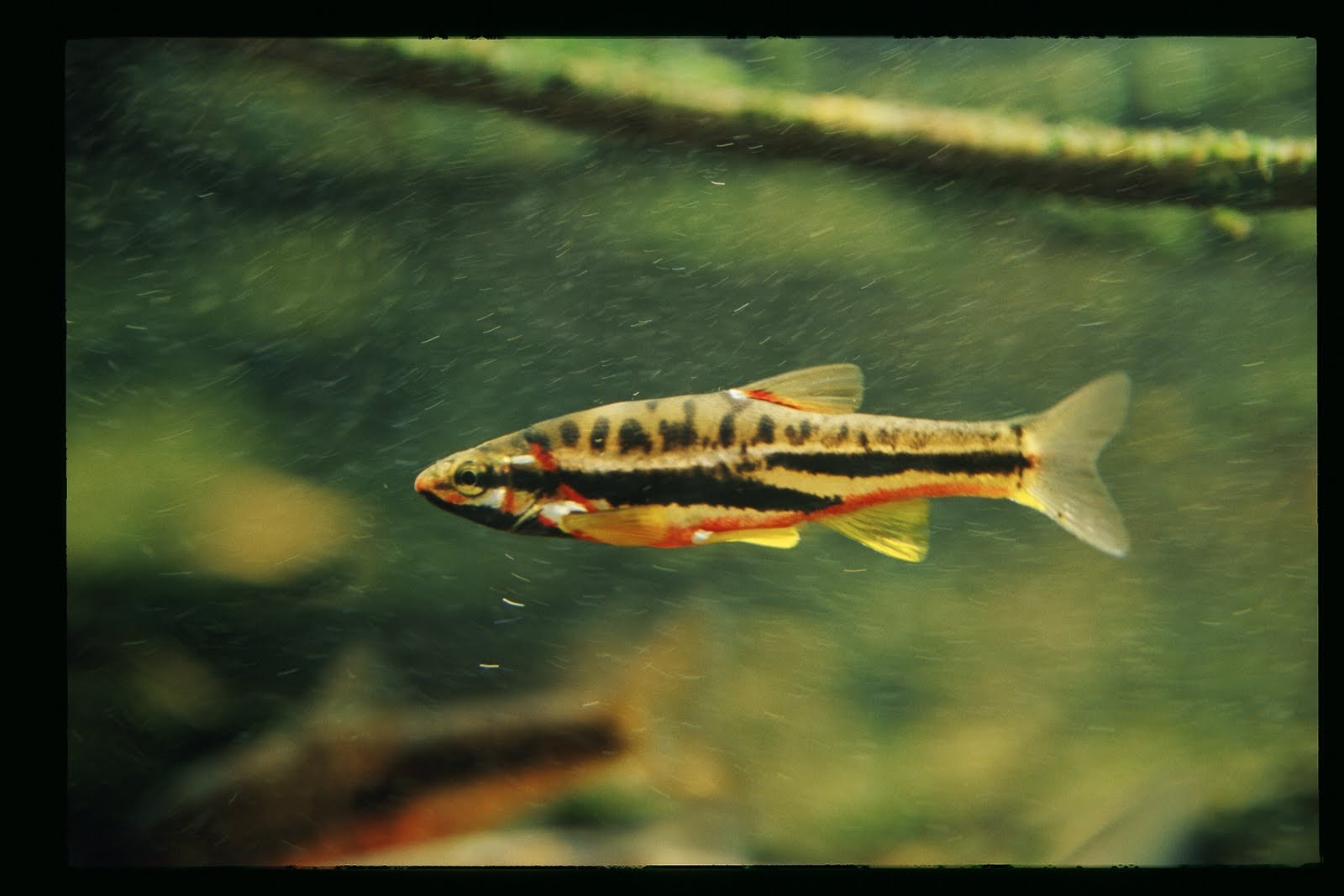
In preparation for the king of darters, we have completely revamped the Mountain Stream exhibit. All of the sculpin (Cottidae) have been removed, as they are known to prey on darters and other small stream fishes. New exhibit rocks have been collected from the Tye River area - smaller, more natural and colorful - to better suit the natural habitat of the logperch. The logperch will join over twenty native stream species currently in this exhibit including redline darters (pictured below), mountain redbelly dace, rosyside dace (pictured above), blacknose dace, and several other darters species.
 A redline darter in the stream exhibit

In the wild, the logperch primarily feed on small invertebrates (bugs, snails, etc) that they uncover by flipping rocks with their snout, here we will feed them a varied diet of blackworms, mysis shrimp and a commercial gel diet.

Thursday, September 8, 2011

cobia

 A five year old cobia in our Chesapeake bay exhibit

Cobia Rachycentron canadum have a dedicated following in this area and thus many cobia fishermen are very secretive about their fishing spots. In addition to being a powerful and challenging adversary for sport-fishermen, they are an excellent food fish; so much so that they are being commercially grown and marketed. Their rapid growth and firm, mild flesh make them an ideal aquaculture species. There is of course much more to them than simply a fillet.

Cobia are fascinating fish and one of the more mysterious fishes in this area. They may be plentiful one day or one week, or nearly impossible to find. They generally migrate into the Bay in early summer and head southward in early fall to overwinter off Florida. Cobia are generally solitary, seeking out structure, but often accompany (or are accompanied by) sharks and rays, adding to their mystique. Also they get large - over 100 pounds - and have a similar shape and movement to that of sharks, giving them even more gravitas. Proof of their allure and uniqueness are their many and varied nicknames: man in the brown suit, bonita, the brown cloud, ling and lemonfish, among others. Another one, crabeater, actually makes sense as they prey heavily on blue crabs.Whatever you call them, their seasonal presence is always highly anticipated.

A young-of-the-year cobia in our Juvenile Fishes exhibit

As with most fishes at the VLM, we usually acquire cobia as juveniles. Firstly, they are infinitely easier to get at this stage and secondly they can be acclimated to captivity much more easily, and most importantly, they are BEAUTIFUL as young (pictured above) and can be displayed immediately. Cobia are extremely "friendly" fish and quite gentle for their size. We currently have four yearlings that are rapidly outgrowing their exhibit and will be added to our largest tank as nearly 2 footers as early as next summer.

Friday, August 26, 2011

blennies

The latter part of each summer is our most productive time to collect specimens. Most recently we have been collecting fishes for our Piling exhibit: blennies, gobies, skilletfish, various crustaceans, and vegetation. Late summer is prime time for these fishes, and Kiptopeake State Park is the place. Over 30 feather blennies, striped blennies, several planehead filefish, and green fleece have been added to the piling exhibit and the old (ecologically incorrect) crushed coral substrate has been replaced with sand. This tank is not only beautiful to look at but very entertaining. Blennies are combative and territorial and actually seem to enjoy fussing at each other. They will literally bite the hand that feeds them (us) and even the cleaning equipment!

A large male feather blenny takes up residence in green fleece


Saturday, July 30, 2011

Roanoke logperch

Roanoke logperch Percina rex

The "king" will soon be at the VLM! The king of what? The king of darters! Darters comprise several Genera of the Family Percidae (perches) and are typically small stream fishes but may inhabit swamps, ponds and lakes as well. And the king is Percina rex - "rex" literally means king - the Roanoke logperch. This fish is not only beautiful, but is one of the largest darters in North America, reaching up to 6 inches. It also is one of the most endangered. Listed as a Federally Threatened and Endangered species, P. rex inhabits only streams in the Roanoke River drainage, but even this small system is losing ground. The Roanoke logperch requires a clean stream bottom to feed and reproduce and many of its native streams are being degraded by sedimentation and human activity.
 Mountain redbelly dace from the Mountain Cove exhibit

We have been lucky enough to acquire some of these rare specimens to display through a loan from the VDGIF's Aquatic Wildlife Conservation Center. The fish were part of a freshwater mussel study and cannot be released into the wild, so they have generously agreed to let us display 10 of their beautiful animals. The aquarium staff and I will be revamping the Mountain Stream exhibit, which currently contains many darter, dace, sculpin and shiner species, to remove many of the darter-eating sculpins currently in the exhibit and add some specialized habitat to accommodate the logperch; they like to overturn rocks with their snouts to search for food. We will also be adding a great deal more darters and dace (such as the mountain redbelly dace pictured above) to the exhibit. Look for the changes around the end of August.
A banded sculpin in the Mountain Stream exhibit, they often prey on smaller stream fishes

Friday, July 15, 2011

Chippy the barn swallow

Juvenile barn swallow

One of the benefits of the museum is that we are exposed to a wide range of animals, not just fish. As a licensed wildlife rehabilitator, I have the opportunity to care for many types of local wildlife from red foxes to barn swallows and everything in between. This swallow (pictured above) was found at Little Creek Reservoir dehydrated, malnourished, and exposed on a very hot day. I have mentored staff member Patrycja Lawryniuk on its care and she thankfully shares the duties caring for it. Birds are often mistakenly picked up by humans who assume they were abandoned - most are not - and people quickly realize that they take an extraordinary amount of care. This little guy is fed every 45 minutes from dawn to dark. Because of its high metabolism it has grown quickly from a fledgling (above) to a flighted adult (pictured below) in less than two weeks.
This handsome bird, nicknamed "Chippy" has thrived primarily on insects, and will soon be released back into the wild to catch his own bugs. When you get an up-close experience with a bird, and I am reminded every time, you realize how delicate, beautiful and complex birds are. And what a joy it is to watch them fly off into the wild. 

***Wild animals, especially birds should only be cared for by licensed caregivers or animal medical professionals. If you do find an injured/orphaned bird here is a helpful website; http://birding.about.com/od/birdingbasics/a/findbabybirds.htm 


Saturday, June 25, 2011

Unusual - but very cool - fishes

There are over 20,000 fish species inhabiting every possible aquatic habitat, so there are some very strange fishes out there. Even in this area, there are many unusual fishes that are relatively abundant, but the average person does not often see. Some of the fishes like the northern stargazer (pictured below) are ambush predators and bury in the sand, so they are deliberately hidden from view.
Others, such as searobins, are often associated with structure, deep water, or active primarily at night. There are a few species of sea robins in Virginia, most common are the northern searobin and the striped searobin (pictured below).

Searobins are occasionally caught on rod and reel while bottom fishing and despite being a good (but small) food fish are nonetheless considered a "trash fish" or nuisance by anglers.

Both these fishes are exceptionally beautiful and have highly modified structures. Stargazers have an electrical organ behind their eye that is thought to be used to stun prey. They also have venom glands at the base of their pectoral fins for defense. Stargazers as so named for the positioning of their eyes that look skyward to locate prey moving overhead as they are entirely buried in sand. Once prey is located, stargazers create enormous suction with their huge mouths and engulf their victims; a move that is almost too fast to see.

Searobins have a large bony head with a duck-like mouth and very specialized pectoral fins. The foremost pectoral fin rays are detached and singular; they can use them like fingers to stir up substrate and locate prey. The remainder of the pectoral fins are very broad and brightly colored (as seen on a northern searobin below). Also they are able to produce sounds through the contraction of muscles surrounding their swim bladder  and - similar to a croaker or oyster toadfish - they are known to croak or grunt loudly when caught.

Thursday, June 16, 2011

More jellies and the lemon sharks claim their first victim

Jellies are standard display animals at public aquaria due to their beauty and downright strangeness. But they are difficult to culture and even more difficult to procure from another institution via trade. So as a short-cut we have been collecting them and displaying what is seasonally available. Right now the resident jelly - and therefore the one currently on display - is the sea nettle Chrysaora quinquecirrha. They are notorious around the Mid-Atlantic for ruining beach outings with their irritating stings, but they are beautiful and plentiful at this time of year. Hopefully, later in the year we will be able to collect and display my local favorite the cannonball jelly Stomolophus meleagris. They are much more difficult to collect as they are very fast swimmers and have excellent senses that allow them to avoid capture; so much so they seem to see you coming and head the other way, quickly!

A sea nettle on display at the VLM

Today marks the first official casualty due to lemon shark aggression. After I performed the routine check-in for the upper level of the building, which includes cleaning the acrylic on the Chesapeake Bay Aquarium, and all seemed well, I was called to the tank by a staff member. A spadefish lay mortally wounded with four large softball-sized chunks removed from it. Apparently, the lemon sharks got hungry and decided to feed themselves. This is problematic on a few levels. Now the sharks have had success devouring a tank mate. There have been bite marks on others but until now all had survived. Also, I value all the animals here including the spadefish and never want to expose animals to uneccessary injury or death. I have raised or collected all of the spadefish (and most of the other species as well) at the VLM and feel responsible for the well-being of each. And lastly, I dive with the sharks, alone for now, and must have a renewed awareness of their activity during dives. While I certainly am not afraid of them at this point, I also do not want to experience the loss of any softball-sized chunk out of me. And as they grow the issues will only escalate.