Sunday, March 16, 2014

Newborn baby lined seahorses - video

These two day old seahorses are just a few from our latest cohort of juvenile lined seahorses Hippocampus erectus. These youngsters require constant attention and therefore have a small tank all to their own. We currently have three separate systems - one for breeding adults, one for "teenagers" and a third for newborns - set up exclusively for raising seahorses to supply our exhibit tank and to potentially outsource to another aquarium. We have had enough success over the past few years to become involved in the lined seahorse Species Survival Plan, or SSP. AZA facilities across the country involved with the SSP breed seahorses in captivity and exchange broodstock to ensure the genetic diversity of the captive populations and more importantly to help reduce stress on wild populations; throughout their range populations of lined seahorses have declined steadily and are currently listed as "vulnerable" by the IUCN. These interesting and intelligent creatures have long been loved to death by those that desire them as pets or worse yet as dried up souvenirs. Seahorses are often caught as by-catch for other species, and like many near-shore species suffer from habitat loss, especially submerged vegetation

To give some perspective to the size of a newborn seahorse, I placed a pencil eraser ( ~1 cm) next to a juvenile seahorse swimming next to the glass front of our nursery tank.In the video you can also clearly see Artemia nauplii; the planktonic larvae of what are commonly called "brine shrimp". Seahorses, especially juveniles feed almost constantly and require live food. The nauplii are hatched here continuously and are enriched with supplements to enhance their nutritional value, but they will soon be transitioned to a more varied diet.
 
Juveniles are highly predatory as soon as they come out of the pouch.

This is a teenage seahorse, that may eventually grow into...

...this handsome devil.


Monday, February 17, 2014

Shortnose Sturgeon Feeding

Sturgeon are ancient creatures, first showing up in the fossil record nearly 200 million years ago. The current Family Acipenseridae, that contains the only two Virginia species of the 23 species, the Atlantic sturgeon A. oxyrhynchus and the shortnose sturgeon A. brevirostrum, has been around for 70 million years! Both species were once abundant in Virginia, but have suffered from overfishing and habitat loss to the point of near extinction; both are listed as Threatened and Endangered. Shortnose sturgeon may temporarily visit Virginia waters from other populations along the East Coast, but are essentially extinct in Virginia, with no viable spawning population left and very few records over the last several decades.
 
Shortnose sturgeon eating pellets with a white sucker
We currently house four shortnose sturgeon  here in our James River exhibit and also temporarily displayed Atlantics during our Jamestown exhibit, however they get so large we could not keep them long-term. Over the years, we have also transferred some shortnose sturgeon to other facilities such as the Maritime Museum in Norwalk to give our current animals more space. Sturgeons can get large and live a long time - females may get 60 + years old and over four feet long- so we need space to keep them comfortable for several decades to come. Currently, our sturgeon are approximately 36 - 40" long and nearly 12 years old. We obtained them as juveniles from a hatchery that raised them from Hudson River stock.

Sturgeon have 4 characteristic barbels beneath their snout 

Sturgeon have physical characteristics that make many visitors mistake them for a type of shark. They are not related, but the comparison has merit. Like sharks, sturgeon have a single dorsal (back) fin, and their tails are both heterocercal or asymmetrical (or the top fork is longer than the bottom). Sturgeon also have unscaled skin similar to a sharks, but sturgeons have bony scutes or plates along their bodies that sharks do not. Both are (mostly) cartilaginous and move in a similar sinuous manner. Despite the cosmetic similarities, sturgeons live a very different lifestyle than sharks.They are adapted to life along the bottom and use their fleshy tube-like mouths to suck prey from substrate, rather than having teeth and jaws like sharks. As seen in the videos, the sturgeon actually suck up much more than the food itself; they take in a mouthful of gravel along with whatever food is available and then spit out the inedible portion. They continually search for food and sift gravel, almost constantly on the move. To help them locate food, they have sensitive barbels just in front of their mouths that "smell" food, similar to catfish "whiskers".


Sturgeons have survived for millions of years but are facing long odds in the future. They grow slowly and mature very late, meaning it may take ten to fifteen years before the newly born young are even able to reproduce and twenty or thirty years before they join their parents as true reproductive adults. Further complicating matters, sturgeon are anadromous and need unblocked passages to even reach their traditional spawning grounds. If they can defy the odds and make it that far, an adult female can lay from 20,000 to 200,000 eggs based upon her size. These eggs are considered a delicacy to humans - Beluga (sturgeon) caviar costs over $2000 a pound! Unfortunately, human activity has altered the riverbanks to such a degree that viable spawning grounds are exceedingly rare because their eggs need clean silt-free gravel in which to develop.But these fascinating fish have outlived humans by millions of years, so they are obviously survivors. Lets just hope we havent yet pushed them past the point of no return. Come see our shortnose sturgeon in the flesh in our James River exhibit!

Tuesday, December 31, 2013

New loggerhead sea turtle "Abe" is on exhibit - Video

The juvenile loggerhead we acquired in October from NC Aquariums is now on exhibit in our Chesapeake Bay Aquarium. The time between his acquisition and his exhibit debut on December 26th was well spent getting him (there actually is no way to tell the gender for many years) acclimated to his feeding schedule through target training. Because Abe now comes to the surface regularly to be fed and has grown accustomed to tank mates, he has graduated from the 1000 holding system to the 30,000 gallon exhibit. He not only has much more space to roam, but also has a much more stimulating environment.

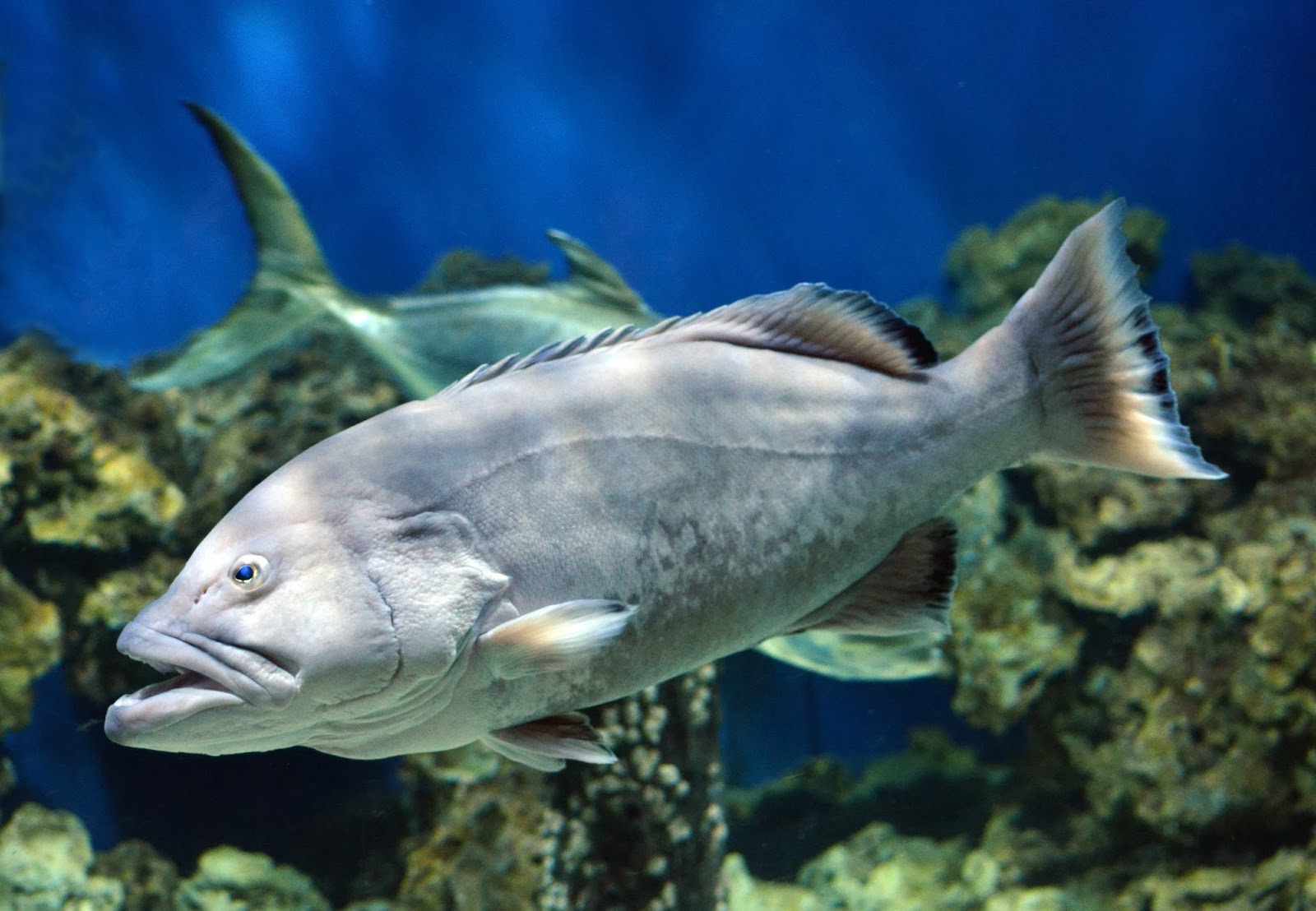
As seen in the first video, Abe - like all our other sea turtles before him - loves to hang out and sleep in the "cave". Though the cave is natural rock we collected nearby, its base structure is an eight foot long acrylic aquarium with plenty of holes cut into is for many entry and exit passages. Abe shares the cave with our resident gag grouper, who has been at the museum for over twelve years.
Our gag grouper Mycteroperca microlepis in front of the cave
So far Abe has settled in nicely to his new home and exhibits no fear of his new tank mates. He has shown to be both calm and inquisitive; good signs for long term success. The videos were taken on a dive his first day on exhibit.


Tuesday, December 17, 2013

Mergansers eating live shiners in the swamp - underwater video!

One of the more interesting aspects of our Cypress Swamp habitarium is the variety of species; from the American alligator and several turtle species to over a dozen fish species. But that's just in the water.


The two-story glassed-in replica of a Virginia swamp also allows enough sunlight for live cypress and magnolia trees to thrive in which live birds make their homes. Brown thrashers, a red headed woodpecker and bobwhite quail can all be seen amongst the branches and boles. In the space between the land and water are our three mergansers. Comically awkward on land, these sleek waterfowl are master swimmers. Their bodies are squat with very rearward legs, making them waddle on land but virtually fly underwater - almost like a penguin bent forward. In the wild, mergansers chase down crayfish, frogs, salamanders and any species of fish small enough to swallow.


Three mergansers easily chase down golden shiners in our Cypress Swamp

Thankfully, most of our fishes are so large, the mergansers pose no threat. In fact, some of the fish species we feature - including the gator - are large enough to turn the tables on an unsuspecting bird or duckling given the opportunity. Both largemouth bass and channel catfish grow large enough and are capable of inhaling large prey items. These adult mergansers however are in no danger, not only are they too large for the fishes, but are too fast and armed with a beak that can discourage even the most aggressive bass. 


Saturday, November 9, 2013

Loggerhead sea turtle training/feeding

This video shows the new turtle learning to feed in her new enclosure at the VLM

Before a new sea turtle is introduced into our Chesapeake Bay Aquarium, we must first ensure (among many other things) that it will be able to acquire food regularly and be accessible to staff. The most common practice is to "target train" them or condition them to associate visual - and often audible - stimuli with food. Fortunately, NC Aquarium had already begun process of training our current turtle to feed regularly from tongs. However, new surroundings have required our new turtle to learn a new routine and feeding schedule before it can safely go into CBA. We began by simply acclimating the turtle to a regular daily feeding at 2 pm daily; this coincides with the time it would be fed when in CBA. As the turtle has become accustomed to staff and its new schedule, we have introduced the visual stimuli - simply a blue Kydex disc on an algae scraper - at each feeding. The new turtle has slowly become accustomed to seeing the target and has begun to equate the presence of the strange blue disc with the magical appearance of food. Eventually, 2 pm = feeding time, target = location of food and we all settle into an efficient and reliable routine.

 A small hand target is placed in the water prior during each feeding
 A sampling of natural foods that the sea turtle gets along with commercial gel diet and supplements
 The new turtle comes up to check out the target prior

One more side note: I like to introduce fishes in the turtle's enclosure as early as possible. First and foremost, the turtle will be amongst much larger fishes in CBA and its beneficial to get it accustomed to the distractions of many fishes. Secondly, the fishes often attempt to steal food from the turtle, as they will on exhibit, so the turtle will begin to actively compete for food and not be startled when it is placed in CBA. And lastly, it gives us a good indicator of the turtle's personality and aggressiveness - or lack thereof.

Wednesday, October 23, 2013

Loggerhead sea turtle release videos - Gulf Stream


After we permanently transferred our unreleasable adult loggerhead sea turtle "Christi" to a larger exhibit at Dallas World Aquarium in 2009, we began to partner with NC aquariums to acquire juvenile sea turtles that we could display for three years and then be released back into the wild. The previous two sea turtles we have displayed at the VLM - Virginia and Abby - have originated from the North Carolina Aquarium at Pine Knoll Shores, including the most recent juvenile (unnamed as yet) we acquired on our trip to release Abby.

A sea turtle nest roped off in Duck, NC

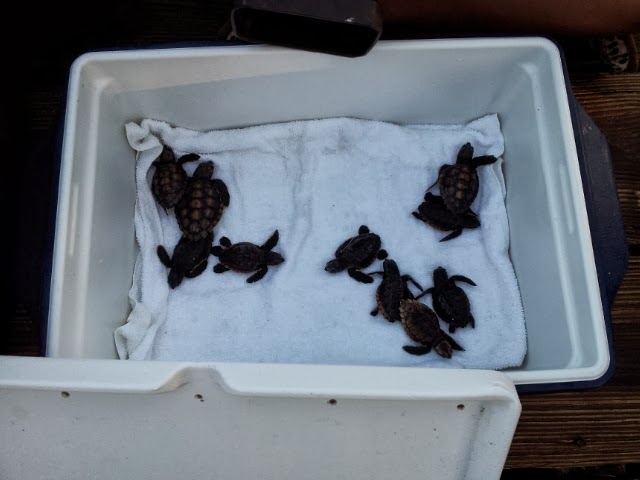
NC Aquariums has an excellent support network of volunteers and trained staff that monitor loggerhead nesting sites along the coastal beaches. They not only protect the nests from being disturbed, but assist the hatchlings to reach the water safely and collect valuable data in the process. The vast majority of hatchlings emerge from the nests healthy and able but many hatchlings do not successfully extract themselves from the nests and may remain buried unless assisted. Once the hatchlings have vacated the nests on their own, the nests are excavated for the stranglers which are then brought back to the aquariums to be nursed back to health or held until they can be released.

A bin of loggerhead hatchlings ready for release by the NC Aquarium

A few of the rescued juvenile turtles are loaned out to other public facilities to serve as educational ambassadors in such places as: Pittsburgh Zoo and PPG Aquarium, Newport Aquarium, Mystic Aquarium, Monterey Bay, and the VLM. Some facilities display the turtles as juveniles and return them after one year; we display the animals for up to three years and then return them to NC for release, and in "Abby's" case, to be affixed with a satellite tag.

Above: VLM Aquarist Patrycja Lawryniuk attaches the satellite tag with epoxy
Below: Close up of the tag that will transmit Abby's location when she surfaces

Just last week we joined these other facilities and their sea turtles at Pine Knoll Shores to release our sea turtle "Abby" along with the others back into their native waters. This time of year the water has begun to cool, so we chartered a SCUBA boat from Discovery Diving  in Beaufort, NC that took us 36 miles offshore in search of warmer Gulf Stream waters. After a three hour boat ride we took turns releasing these beautiful, prehistoric creatures out into the wild. One by one, each facility had the honor of releasing the turtles in their care back into the ocean. Fortunately, I brought along a wet suit and small underwater camera to capture the releases on film.

A hatchling at release


The ocean can make one feel very small, especially untethered miles and miles offshore. The expanse seems infinite. But sea turtles are here after all these millions of years because deep within them lies the knowledge and instinct to survive out there, to find food, to find each other. As Abby glided off into the emerald sea far beyond my reach and out of site, in the last few seconds I would see her - after seeing her and caring for her daily for three years, I caught the final glimpse of who she really is and what she is meant to do; a small thing really. She flapped briefly to gather speed, to test her freedom and then spread her back flippers and glided with the current, slipping weightless, riding the powerful current to some unseen destination with no hesitation or fear.


As of 10/24/2013, Abby has traveled a total distance of 693km (that's about 430 miles!)! You can follow her progress at http://www.seaturtle.org/tracking/?tag_id=128947


Saturday, October 5, 2013

Redbreast sunfish fry development

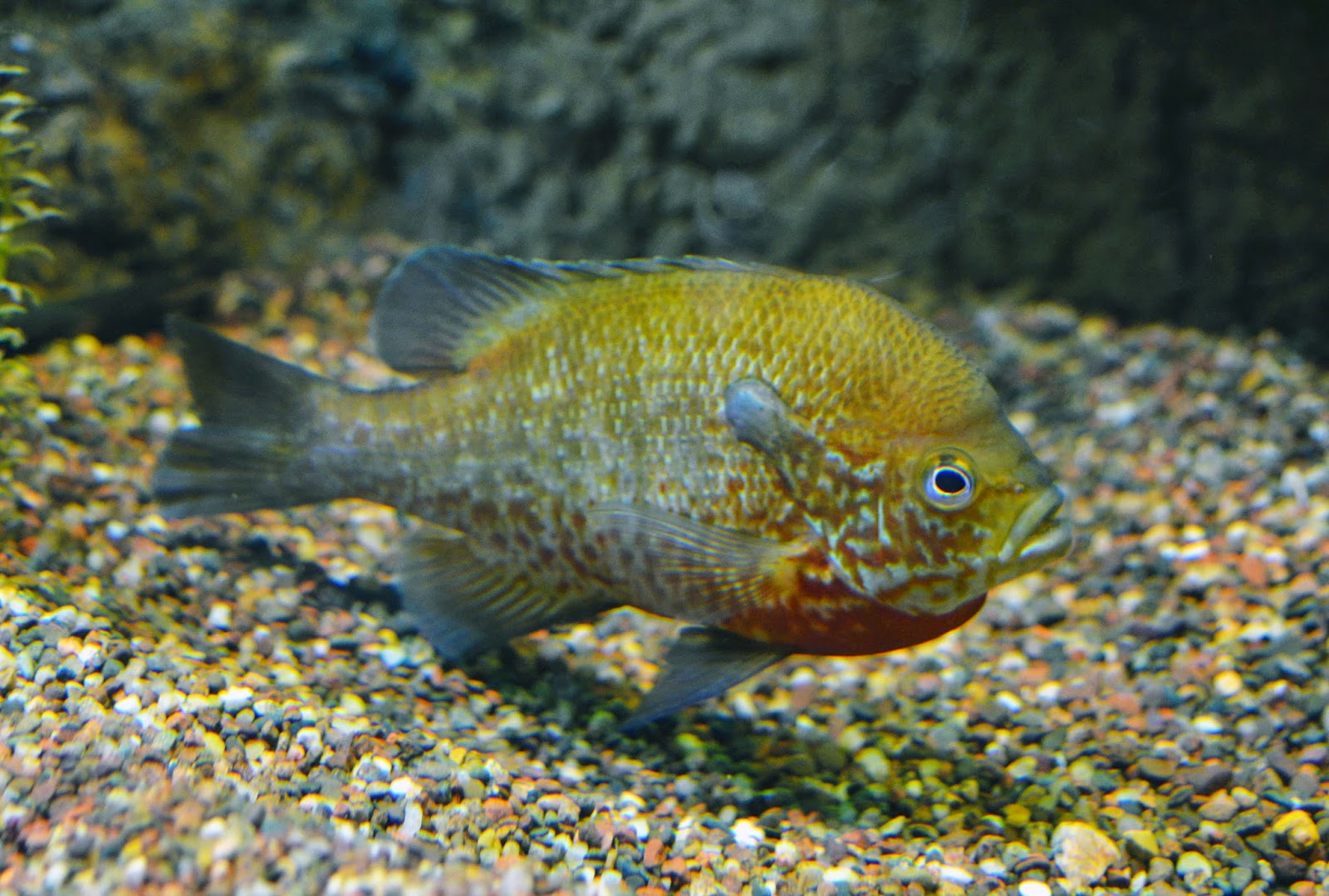
A large male redbreast Lepomis auritus in breeding colors

The term "sunfish" generally refers to fishes from the Family Centrarchidae, comprised of 30 species (including several bass species and crappie), but to most people "sunfish" are species from the Genus Lepomis: bluegill, pumpkinseed, longear, warmouth, redear, green, and redbreast sunfishes. To further complicate matters, Lepomis species can - and often do - hybridize with each other especially in captivity (see below). 
 A large male pumpkinseed/redbreast hybrid Lepomis gibbosus on his nest

Most sunfishes spawn in early to mid summer, when the water temperatures begin to approach 70 degrees F. However, in captivity many species - not just sunfishes - are triggered to spawn at unusual times of the year, due to unnatural light cycles and seasonal temperature fluctuations within the facility. For example, two species of sunfish in our Woodland Pond exhibit, the pumpkinseeds and redbreasts are currently spawning, but are several months past their spawning period in the wild.

Breeding or "nuptial" males of all sunfish species fan out broad, saucer-shaped nests with their tails in hopes of attracting a female. The males then aggressively guard these nests which are often quite close together, and chase off all intruders. During this period males become brilliantly colored, showing off their best and brightest for the ladies. If the male successfully attracts a mate, he will fertilize from 1000's to 10's of thousands of eggs, depending upon the size of the female (and species), which she has deposited in the nest. After releasing her eggs, she moves on with no further commitment to the young. The males remain to guard their young from predators as the young develop from eggs to yolk sac larvae to free-swimming larvae. Once the young are swimming and feeding on their own, the job of the male is finally done.

 Eggs are approximately 1 mm


Redbreast fry that have just lost their yolk sac

Fry one week later ( 2 -3 weeks total)
...another week older (4- 5 weeks)
Fry seven to eight weeks after hatching.